News

Lawrence Tech Named the Nation’s No. 3 School for Automotive Engineering

Lawrence Tech Named the Nation’s No. 3 School for Automotive Engineering 800 413 Southfield City Centre

SOUTHFIELD—Lawrence Technological University has been named the No. 3 automotive engineering university in the nation, according to College Gazette, a college ranking website.

LTU offers a Master of Science degree in automotive engineering, as well as a Bachelor of Science in mechanical engineering with a concentration in automotive engineering.

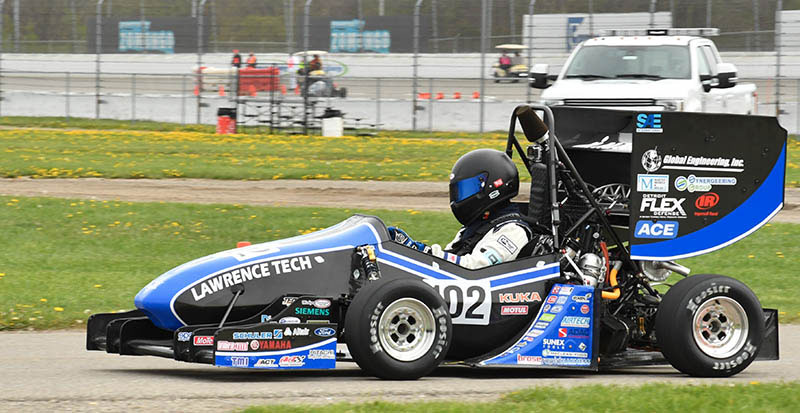
LTU students participate in international competitions, such as Formula SAE, Formula Electric, Baja SAE, and SAE Supermileage, and rank among the top performing teams. Graduates seek additional learning opportunities through applied research projects and doctoral programs. And LTU’s alumni are numerous among the Detroit Three, Michigan auto suppliers, and automakers and suppliers around the globe. Ford Motor Co., General Motors and Stellantis employ more LTU graduates than any other employers.

LTU also houses a state-of-the-art Johnson Controls Inc. Vehicle System Engineering Lab which supports applied research focused on creating new knowledge in the field of automotive engineering with a four-wheel independent chassis dynamometer, robot driver, and data acquisition system. Research capabilities include vehicle dynamics, fuel economy, driveline technology, safety, advanced materials, fasteners, emerging energy technologies, controls, and more.

PayScale sets the median salary for an automotive engineer at $79,126. The Bureau of Labor Statistics sets the median salary for all mechanical engineers at $90,160, and says job growth is expected at about 4 percent over the next 10 years.

Michigan had three universities on the top ten list. In addition to LTU, Kettering University and Ferris State University were also acknowledged.

Lawrence Technological University, www.ltu.edu, is a private university founded in 1932 that offers nearly 100 programs through the doctoral level in its Colleges of Architecture and Design, Arts and Sciences, Business and Information Technology, and Engineering. PayScale lists Lawrence Tech among the nation’s top 11 percent of universities for the salaries of its graduates, and U.S. News and World Report lists it in the top tier of best Midwestern universities. Students benefit from small class sizes and a real-world, hands-on, “theory and practice” education with an emphasis on leadership. Activities on Lawrence Tech’s 107-acre campus include more than 100 student organizations and NAIA varsity sports.

LTU’s Centrepolis Accelerator Part of New Partnership to Boost Energy Innovation

LTU’s Centrepolis Accelerator Part of New Partnership to Boost Energy Innovation 800 532 Southfield City Centre

SOUTHFIELD—The Centrepolis Accelerator at Lawrence Technological University is one of four organizations selected to receive more than $900,000 from the Energy Program for Innovation Clusters (EPIC), sponsored by the U.S. Department of Energy’s Office of Technology Transitions.

The other institutions in what’s being called the Midwest Regional Innovation Partnership are mHUB, a manufacturing business accelerator in Chicago, the Chicago-based green energy investors Clean Energy Trust, and Spark Innovation Center in Knoxville, Tenn., an initiative of the University of Tennessee Research Park.

The partnership will support new and existing programs for venture acceleration of energy hardware startups in the Midwest. The partners plan to support more than 360 startups and small businesses via the tailored programs, which include both virtual and in-person events, sector-specific curricula, mentorship, prototyping resources, and connections with industry. Beneficiaries of the program will be a diverse array of founders from across the region, including those from universities, low-income communities, and urban areas.

Two of the DOE’s Lab-Embedded Entrepreneurship Programs, Chain Reaction Innovations based at Argonne National Laboratory and Innovation Crossroads based at Oak Ridge National Laboratory, will serve as project affiliates, along with the National Renewable Energy Laboratory.

EPIC is a $10 million program created by the DoE’s Office of Technology Transitions to underscore the importance of regional clusters, which increase productivity of area companies, drive the direction and pace of innovation, and stimulate the formation of new businesses. For a full list of EPIC awardees, visit the Office of Technology Transitions’ website. The intent of the program is to increase the commercialization of energy hardware technologies to reduce energy consumption and emissions while increasing domestic manufacturing, creating U.S. intellectual property, and creating well-paying jobs in the Midwest.

“The Midwest Regional Innovation Partnership program enables a unique and more direct collaboration between accelerators, national labs, investors and other key stakeholders to advance cleantech hardware technology,” said Dan Radomski, executive director of the Southfield-based Centrepolis Accelerator. “This program allows Centrepolis to offer our services more broadly throughout the Midwest including utilizing our unique product development, prototyping and manufacturing readiness capabilities. This includes making our annual C3 Accelerator and its $1.65 million seed fund available to support cleantech, climatech and circular economy technology companies throughout the Midwest to drive the launch of more domestically manufactured cleantech hardware products and at the same time deploying these innovations to support our nation’s decarbonization goals.”

“At Clean Energy Trust, we see firsthand how hardware-based energy startups face unique challenges in scaling and attracting capital,” said Erik Birkerts, CEO at Clean Energy Trust. “This partnership will build upon the Midwest region’s long standing legacy of manufacturing and innovation to support climate technologies as they prepare to bring their innovations to market.”

“Energy Tech is a critical technology investment area for our country: one that can support advanced manufacturing domestically while addressing climate challenges globally,” said Haven Allen, co-founder and CEO of mHUB. “There is extraordinary demand from early-stage startups for hardtech specific investment and resources here in the United States. mHUB connects entrepreneurs to these tools, both locally and nationally, and helps them build paths to successful commercialization. Thank you to the DOE for the opportunity to bolster our regional connectedness for innovation in energy.”

“The Spark Innovation Center will work closely with TVA and the Tennessee Advanced Energy Business Council to develop and deliver a new Cleantech Accelerator in Tennessee in close collaboration with our MRIP partners,” said Tom Rogers, President and CEO of the UT Research Park.

About the Centrepolis Accelerator

The Centrepolis Accelerator at Lawrence Technological University is accelerating the growth of Michigan’s cleantech, advanced manufacturing, innovative hardware entrepreneurs and small manufacturers by providing access to funding, experts and key business and product development resources. Visit centrepolisaccelerator.com.

Lawrence Technological University, www.ltu.edu, is a private university founded in 1932 that offers nearly 100 programs through the doctoral level in its Colleges of Architecture and Design, Arts and Sciences, Business and Information Technology, and Engineering. PayScale lists Lawrence Tech among the nation’s top 11 percent of universities for the salaries of its graduates, and U.S. News and World Report lists it in the top tier of best Midwestern universities. Students benefit from small class sizes and a real-world, hands-on, “theory and practice” education with an emphasis on leadership. Activities on Lawrence Tech’s 107-acre campus include more than 60 student organizations and NAIA varsity sports.

About Clean Energy Trust

Clean Energy Trust provides catalytic capital and support to early-stage startups in the Mid-Continent region of the United States working on solutions for clean energy, decarbonization and environmental sustainability. Based in Chicago, Clean Energy Trust invests in and provides hands-on support to help entrepreneurs scale and succeed. To date, Clean Energy Trust has helped its 36 portfolio companies raise $31 of additional investment for every $1 Clean Energy Trust has invested. Clean Energy Trust is proud that 60% of its portfolio companies have female or minority founders. Learn more at www.CleanEnergyTrust.org.

About mHUB

mHUB is a leading independent hardtech and manufacturing innovation center that exists to convene the entrepreneurial ecosystem around physical product innovation to ensure that the manufacturing industry continues to accelerate, grow and thrive. The mHUB community includes over 428 active and alumni startups and small businesses supported by a deep talent pool of product designers and developers, entrepreneurs, engineers and manufacturers, corporate leaders, industry experts, mentors and investors. mHUB provides a hyper-resourced environment to entrepreneurs with the goal of commercializing new hardtech innovation that will lead to new businesses, intellectual property, investment, revenue and job creation. Since launching in 2017, the mHUB community has generated more than $430M in revenue, launched more than 1,256 products, hired more than 2,153 employees, and raised nearly $702M in capital. For more information visit mhubchicago.com.

About Spark Innovation Center

The Spark Innovation Center is an initiative of the University of Tennessee Research Park, and builds on the facilities and expertise at the University, Oak Ridge National Laboratory (ORNL), and the Tennessee Valley Authority (TVA). Spark focuses on helping promising energy technology companies grow, offering access to top quality lab space, expert mentoring, and coordinating support services from nine partner organizations in the region.


LTU Gets Second Autonomous Electric Vehicle

LTU Gets Second Autonomous Electric Vehicle 795 795 Southfield City Centre

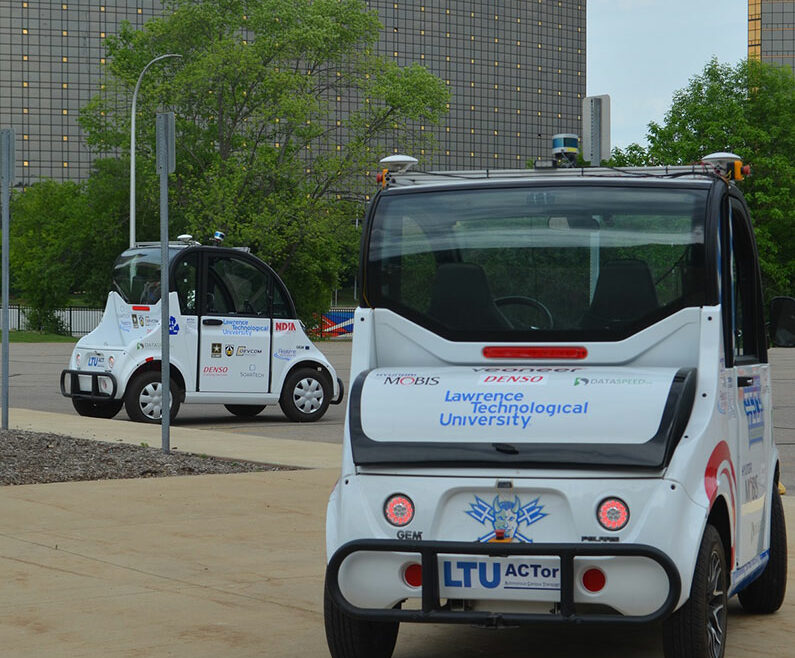
SOUTHFIELD—Lawrence Technological University celebrated the gift of a second Gem e2 electric vehicle in an outdoor ceremony Tuesday at the university’s Southfield campus.

The university’s computer science program has turned the two-seat car into a second autonomous vehicle research platform for students to learn to develop software for the self-driving cars of the future.

Sponsors recognized included the United States Army’s DEVCOM Ground Vehicle Systems Center in Warren, the National Defense Industrial Association Michigan Chapter, the military business consultant Great Lakes Systems and Technology, the auto supplier DENSO, the Ann Arbor artificial intelligence technology developer SoarTech, the Ann Arbor simulation software developer Realtime Technologies, and the Rochester Hills drive-by-wire systems developer Dataspeed Inc.

LTU Provost Tarek Sobh, a robotics engineer by background, noted that Lawrence Tech is one of only 13 comprehensive, doctoral, private technological universities out of more than 6,000 institutions of higher learning in the country, “and that there is no project that embodies that unique nature like these vehicles.” LTU also offers one of the nation’s few fully accredited undergraduate robotics engineering programs, he added.

Lawrence Tech is also adding a new graduate program, a Master of Science in artificial intelligence, that has a concentration related to autonomous vehicle development. 

C.J. Chung, professor of computer science at LTU, has long spearheaded the university’s push into developing autonomous vehicles. He said the next step for the program is to develop high school summer camps where talented younger students can learn to program autonomous vehicles using the computer language Python with ROS (Robot Operating System). 

Lawrence Tech will be competing June 4-7 in the Intelligent Ground Vehicle Competition, where it is three-time defending champion in developing autonomous driving capabilities. The competition is held at Oakland University in Rochester. It was cancelled last year due to the pandemic, but is being held this year with protective protocols in place.

Lawrence Technological University, www.ltu.edu, is a private university founded in 1932 that offers nearly 100 programs through the doctoral level in its Colleges of Architecture and Design, Arts and Sciences, Business and Information Technology, and Engineering. PayScale lists Lawrence Tech among the nation’s top 11 percent of universities for the salaries of its graduates, and U.S. News and World Report lists it in the top tier of best Midwestern universities. Students benefit from small class sizes and a real-world, hands-on, “theory and practice” education with an emphasis on leadership. Activities on Lawrence Tech’s 107-acre campus include more than 60 student organizations and NAIA varsity sports.


LTU Named a ‘Best Value College’ by the Princeton Review

LTU Named a ‘Best Value College’ by the Princeton Review 500 500 Southfield City Centre

Lawrence Technological University is one of the nation’s top colleges for students seeking a superb education with great career preparation and at an affordable price, according to The Princeton Review, the Framingham, Mass.-based educational services company.

The education services company named Lawrence Tech as a Best Value College for 2021 in a feature the company posted on its website on April 20 at https://www.princetonreview.com/college-rankings/best-value-colleges/ . The feature profiles 200 schools that The Princeton Review selected out of more than 650 institutions the company considered and surveyed for this year’s project.

Information on the Best Value Colleges for 2021 project and its seven categories of ranking lists, as well as profiles of Lawrence Tech and other selected schools, is accessible at no charge with registration on The Princeton Review’s website.

“The latest results from this well-regarded ranking is further demonstration that an education at Lawrence Technological University is well worth the investment in our students’ time and money,” LTU President Virinder Moudgil said. “Lawrence Tech graduates are in high demand in some of the fastest-growing occupations—jobs that provide both good salaries and opportunities to improve the future of society.”

The Princeton Review chose its Best Value Colleges for 2021 based on data the company collected from its surveys of administrators and students at more than 650 colleges in 2019-20. The company also factored in data from PayScale.com surveys of alumni about their starting and mid-career salaries and job satisfaction figures.

In all, The Princeton Review analyzed more than 40 data points to tally ROI (Return on Investment) ratings of the colleges that determined its selection of the 200 schools for the 2021 project. Topics covered everything from academics, cost, and financial aid to graduation rates, student debt, alumni salaries, and job satisfaction. Lawrence Tech’s ROI ranking can be found at https://www.princetonreview.com/college/lawrence-technological-university-1023483?ceid=ctpyb#!careers.

“The schools we name as our Best Value Colleges for 2021 comprise only just over 1 percent of the nation’s four-year colleges,” noted Robert Franek, The Princeton Review’s editor-in-chief. “They are distinctive in their programs, size, region, and type, yet they are similar in three areas. Every school we selected offers outstanding academics, generous financial aid and/or a relative low cost of attendance, and stellar career services. We salute Lawrence Tech for these exceptional offerings and recommend it highly to college applicants and parents.”

The Princeton Review’s editors noted that “students don’t often discuss a school’s motto, but with Lawrence Technological University’s motto of ‘Theory and Practice,’ they’re eager to share how they feel the school’s greatest strength is how involved you become in your major…It’s all praise for the ‘exceptional’ academics across all programs from industrial design to biomedical engineering…Undergrads love that their coursework often has a ‘hands-on aspect; it isn’t all about hitting the books.’ They also appreciate that professors are not only ‘technologically advanced,’ but ‘still in the industries they teach in.’”

In the student surveys, LTU students described themselves as “hard working, dedicated, and determined,” “extremely friendly,” and that “everyone is a techie.” Undergraduates pride themselves on the fact that the university attracts “people from all over the world.” But ultimately, no matter where they grew up, “students at LTU get to know each other fast and form a family. We help each other in courses and lift each other up.”

The Princeton Review is a tutoring, test preparation, and college admission services company. Every year, it helps millions of college- and graduate school-bound students achieve their education and career goals through online and in-person courses delivered by a network of more than 4,000 teachers and tutors, online resources, and its more than 150 print and digital books published by Penguin Random House.

Lawrence Technological University, www.ltu.edu, is a private university founded in 1932 that offers nearly 100 programs through the doctoral level in its Colleges of Architecture and Design, Arts and Sciences, Business and Information Technology, and Engineering. PayScale lists Lawrence Tech among the nation’s top 11 percent of universities for the salaries of its graduates, and U.S. News and World Report lists it in the top tier of best Midwestern universities. Students benefit from small class sizes and a real-world, hands-on, “theory and practice” education with an emphasis on leadership. Activities on Lawrence Tech’s 107-acre campus include more than 60 student organizations and NAIA varsity sports.

LTU Expo Gaming, Anime Fest Returns in Virtual Form

LTU Expo Gaming, Anime Fest Returns in Virtual Form 500 500 Southfield City Centre

The LTU Expo (LTUX), a celebration of anime, gaming, and Esports events, returns to Lawrence Technological University after the coronavirus pandemic canceled the 2020 event.

The virtual event will be held from Monday, April 19 to Saturday, April 24.

The event will present the advanced project work of LTU game design and computer science students, along with the products and services of local game developers and business partners, plus Esports tournaments, keynotes, panels, and more.

For more information and a complete schedule, visit https://ltux.games/. The website, says LTUX shows “everything LTU has to offer: great work, a friendly and welcoming studio culture, and amazing potential.”

Faculty advisers for the event are Mars Ashton, assistant professor of game design, and Jose Gonzalez-Belmonte, game software development lecturer.

Said Ashton: “LTUX has always been something our students have looked forward to at the end of the school year. We are excited to be able to bring so much of what LTU offers to this virtual event and look forward to the time we’ll be able to host it on-campus again!”

LTU offers both a Bachelor of Fine Arts in game design and a Bachelor of Science in computer science with a game software development concentration. More about the BFA in game design at this link. More about the Bachelor of Science in computer science game software development degree at this link.

The initial LTU Expo, held on campus in 2018, drew a crowd of more than 1,200 to LTU’s Southfield campus. A similar-sized crowd attended in pre-pandemic 2019.

Lawrence Technological University, www.ltu.edu, is a private university founded in 1932 that offers nearly 100 programs through the doctoral level in its Colleges of Architecture and Design, Arts and Sciences, Business and Information Technology, and Engineering. PayScale lists Lawrence Tech among the nation’s top 11 percent of universities for the salaries of its graduates, and U.S. News and World Report lists it in the top tier of best Midwestern universities. Students benefit from small class sizes and a real-world, hands-on, “theory and practice” education with an emphasis on leadership. Activities on Lawrence Tech’s 107-acre campus include more than 60 student organizations and NAIA varsity sports.

Lean Rocket Lab, Lawrence Tech’s Centrepolis Accelerator Receive Federal Grant to Grow COVID-19 Response

Lean Rocket Lab, Lawrence Tech’s Centrepolis Accelerator Receive Federal Grant to Grow COVID-19 Response 800 532 Southfield City Centre

U.S. Secretary of Commerce Gina Raimondo announced this week that a total of $29 million would be awarded to 44 organizations as part of the Economic Development Administration’s (EDA) Scaling Pandemic Resilience Through Innovation and Technology (SPRINT) Challenge. This includes a $569,300 federal grant from the Department of Treasury’s Community Development Financial Institutions Fund (CDFI Fund) for Lean Rocket Lab, a Jackson, Mich.-based business incubator and accelerator that supports and invests in high- growth, high-impact companies across Michigan.

The SPRINT Challenge was launched last year to harness America’s entrepreneurial potential to address the economic, health, and safety risks caused by the coronavirus pandemic through entrepreneurship and innovation, according to the EDA.

“Michigan startups and entrepreneurs have proven their innovation and ingenuity time and again over the past year, developing innovative ways to keep our communities safe through COVID- 19,” said Governor Gretchen Whitmer. “We applaud Lean Rocket Lab and Lawrence Technological University for their work in earning these federal resources and look forward to seeing how their efforts continue to help us put this pandemic behind us together, once and for all.”

The funding will support Lean Rocket Lab’s Manu-Tech Virtual Incubator Covid Response Unit, which is being led in partnership with Lawrence Technological University’s Centrepolis Accelerator, both of which are part of the statewide SmartZone network supported by the Michigan Economic Development Corporation (MEDC). The project will deliver virtual programming, mentorship, incubator facilities, access to statewide manufacturing partners and suppliers, and access to the state of Michigan’s startup community and investor network.

The goal of the program is to expand access to the resources available through Lean Rocket Lab’s programming and support the ongoing engagements with client companies. It is also anticipated to bring 20 new companies to Michigan, create 120 jobs, and generate $25 million in new client investment capital.

“The program was inspired by the incredible entrepreneurs we’ve seen from across the state and the globe, who have developed and deployed critical technology focused on solving the very real challenges presented by the pandemic,” said Lean Rocket Lab CEO Brandon Marken. “We’ve seen tremendous density of technology that supports operational resiliency in manufacturing. These types of technologies are critical to keeping factories open and people working. Connected worker platforms, computer vision and AI-based inspection, on-demand manufacturing, and much more. We want to continue to support these entrepreneurs with critical access to our manufacturing community, expertise, our investor network and virtual programming.”

Added Dan Radomski, executive director of Lawrence Technological University’s Centrepolis Accelerator: “The ManuTech Virtual Incubator programming has been a critical component of the Michigan entrepreneurial ecosystem and we have been thrilled to be Lean Rocket Lab’s regional partner for the last few years. This SPRINT project deepens our relationship and allows us to deploy our deep bench of technical talent and engineering resources to high-growth startups and entrepreneurs as they integrate commercialize and deploy their technology.”

According to Radomski, LTU Centrepolis Accelerator has specific expertise in helping startups in de-risk through Manufacturing, Technology and Commercial Readiness Level coaching.

“The SPRINT Challenge builds on EDA’s efforts to work with communities to build strong regional economies,” said Dennis Alvord, Acting Assistant Secretary of Commerce for Economic Development. “Our grantees’ projects are laser-focused on using innovation to help America overcome the economic, health, and safety challenges brought on by the pandemic.”

About Lean Rocket Lab

The Lean Rocket Lab removes common barriers to innovation by providing a collaborative workspace full of high energy entrepreneurs, advanced educational programming, and helpful resources so businesses and products can launch and thrive. Strategically located in one of the most diverse manufacturing economies and backed by access to experts, capital, prototyping, engineering, marketing, and technology resources, the Lean Rocket Lab is the place where entrepreneurs on the I-94 corridor come to get things built. For more information, visit leanrocketlab.info.

About Lawrence Technological University’s Centrepolis Accelerator

The Centrepolis Accelerator at Lawrence Technological University is accelerating the growth of Michigan’s advanced manufacturing, innovative hardware entrepreneurs and small manufacturers by providing access to funding, experts and key business and product development resources. Visit centrepolisaccelerator.com.

Defense Industry Group Becomes Sponsor of Lawrence Tech Autonomous Vehicle Team

Defense Industry Group Becomes Sponsor of Lawrence Tech Autonomous Vehicle Team 1200 794 Southfield City Centre

SOUTHFIELD—The National Defense Industrial Association (NDIA) Michigan Chapter has become a sponsor of Lawrence Technological University’s team in a global competition for autonomous vehicles.

“In our efforts to both promote STEM (Science , Technology, Engineering and Mathematics) education and connect the defense industry with academia, we were pleased and honored to assist LTU in this global competition,” said Patty Lopez, NDIA Michigan Chapter STEM director.

LTU is developing two fully autonomous and fully collaborative self-driving vehicles. LTU now owns  two Polaris GEM e2 two-seat electric vehicles, and the LTU team is using a variety of sensors, systems, and software to turn them into fully autonomous and fully collaborative self-driving vehicles, according to C.J. Chung, LTU professor of mathematics and computer science and the faculty leader on the project.

The overall effort began in 2018 with a three-year, $150,000 subcontract from the U.S. Army’s Ground Vehicle Systems Center (GVSC), subcontracted through Chesterfield Township-based Great Lakes Systems & Technology LLC, a ground vehicle technology and engineering firm.

Chung and a team of LTU faculty and students are now fitting the second GEM e2 vehicle with cameras, laser-based radar, GPS systems, and computers to make it autonomous. Chung said the biggest and most challenging task is developing software for self-driving vehicle functions, since that must be built from the ground up.

Chung said an invitation-only dedication of the second vehicle is planned for May on LTU’s campus. LTU’s cars will compete in the 2021 Intelligent Ground Vehicle Competition, scheduled for June 4-7 at Oakland University (see www.igvc.org). (The 2020 competition was canceled due to the coronavirus pandemic.)

Other sponsors of the LTU IGVC team are: Dataspeed Inc., the Rochester Hills autonomous vehicle products and services provider; DENSO, the Japanese auto supplier; Soar Technology Inc., the Ann Arbor-based artificial intelligence firm; and RealTime Technologies, the Ann Arbor-based driving simulation developer.

Working with Chung are faculty co-sponsors Nick Paul, an LTU alumnus, adjunct faculty member, and Soar Technology employee, and Joe DeRose, an LTU adjunct faculty member and Ford Motor Co. employee. Another LTU graduate, Mitchell Pleune, now an employee of Veoneer, the Swedish automotive electronics developer with U.S. headquarters in Southfield.

Team members are LTU students Thomas Brefeld, Justin Dombecki, James Golding, and Joseph Schulte. Dombecki and Golding are working toward master’s degrees in computer science, while Brefeld and Schulte are working toward a bachelor’s degree in computer science.

Lawrence Technological University, www.ltu.edu, is a private university founded in 1932 that offers nearly 100 programs through the doctoral level in its Colleges of Architecture and Design, Arts and Sciences, Business and Information Technology, and Engineering. PayScale lists Lawrence Tech among the nation’s top 11 percent of universities for the salaries of its graduates, and U.S. News and World Report lists it in the top tier of best Midwestern universities. Students benefit from small class sizes and a real-world, hands-on, “theory and practice” education with an emphasis on leadership. Activities on Lawrence Tech’s 107-acre campus include more than 60 student organizations and NAIA varsity sports.

The NDIA Michigan Chapter Connects to Protect Our Nation. It supports our nations’ warfighters by being the premier connector within Michigan’s defense community. The NDIA Michigan Chapter is an organization with a passion for bridging the gap between those who provide and those who use the best and latest in equipment and technology to keep our nation and its defenders safe.

LTU Science & Technology Showcase shows off student talent in the life sciences

LTU Science & Technology Showcase shows off student talent in the life sciences 500 500 Southfield City Centre

The life sciences expertise of Lawrence Technological University students will again be on full display as the university conducts its fourth Science and Technology Showcase on Wednesday, April 28.

The event will be streamed live online from 2 to 4 p.m. This year’s theme is “Bench to Bedside: Moving Medical Devices and Technology from Concept to Clinical Application.”

The event will feature a panel discussion moderated by Jaideep Rajput, director of commercialization at Beaumont Health. Panelists include M. Therese Jamison, director of the Bachelor of Science in Nursing program at LTU; Brianna Riley, manager at Henry Ford Innovations, the technology commercialization arm of Henry Ford Health; and Fred Molnar, vice president of entrepreneurship and innovation at the Michigan Economic Development Corp.

They’ll discuss what hospitals and health networks are doing to engage with companies, how a startup can get the most out of conducting pilot studies with a health care system partner, how early stage companies can work with health care systems to generate user experience for new technologies, and how and why health care organizations should share their technical expertise.

Also at the Showcase, dozens of LTU students will show off their senior capstone projects and other research in a virtual poster session. The presenting students are majoring in biomedical engineering, nursing, molecular and cell biology, and other life science disciplines.

LTU’s curriculum combines scholarship, research, and real-world applications. Many employers over the years have found valuable talent at the Showcase.

The event is free and open to the public. To register, visit https://ltu.joinhandshake.com/events/716765/share_preview.

LTU began holding the event in the spring of 2017. The 2020 event was canceled due to the pandemic.

Lawrence Technological University, www.ltu.edu, is a private university founded in 1932 that offers nearly 100 programs through the doctoral level in its Colleges of Architecture and Design, Arts and Sciences, Business and Information Technology, and Engineering. PayScale lists Lawrence Tech among the nation’s top 11 percent of universities for the salaries of its graduates, and U.S. News and World Report lists it in the top tier of best Midwestern universities. Students benefit from small class sizes and a real-world, hands-on, “theory and practice” education with an emphasis on leadership. Activities on Lawrence Tech’s 107-acre campus include more than 60 student organizations and NAIA varsity sports.

Attend a Virtual Job Fair on January 26

Attend a Virtual Job Fair on January 26 1080 1080 Southfield City Centre

Job seekers have a safe way to interact with potential employers at a virtual job fair on January 26, 2021 from 1-4 p.m.

The virtual job fair, hosted by Oakland County Michigan Works!, in partnership with the City of Southfield and the City of Oak Park, is a chance for individuals who are seeking a variety of types of jobs to connect with employers across many industries in a safe, socially distant way, online.

“This is an opportunity for job seekers to meet with a variety of employers virtually,” says Jeffrey Granat, program operation coordinator with Oakland County Michigan Works! Southfield, which is located on Civic Center Drive in the Southfield City Centre. “Job seekers can move from booth to booth, read about the employers and learn about their job openings.”

Participants can chat with potential employers and have a brief interview. “Employers do a nice job of putting together booths to entice jobseekers to learn more about their company and to chat with their representatives,” Granat says.

Across the multi-industry fair, employers are seeking a diverse group of employees from cleaners, environmental attendants, call center workers, logistics specialists, human services workers, transportation employees, cooks, certified nursing assistants and more. The virtual platform can accommodate as many as 30 employers, so there will be a variety of industries represented.

“There are a variety of different employers here and we try to offer something for everyone. There will be small companies and big companies from different industries. We want people to know there is something for you here,” Granat says. “Oakland County Michigan Works! will also have a booth to provide tips on resume writing and interviewing, and other tips for people seeking employment.”

Job seekers can use a computer, laptop or tablet to participate and will connect through a user-friendly job fair tool. Job seekers should register and build a profile and they can upload a resume. “The more information a job seeker can provide, the better,” Granat says.

Even during the pandemic, Oakland County Michigan Works! and the City of Southfield are working to ease unemployment and provide safe ways for individuals to return to work.

“It’s great that we have been able to put this virtual job fair together to help job seekers throughout southeast Michigan get back to work,” Granat says.

Learn more about the virtual job fair at Oakland County Michigan Works! Southfield: OaklandCountyMIWorks.com. Or contact Jeffrey Granat at jgranat@cityofsouthfield.com.

Job seekers can register for the virtual job fair at: app.brazenconnect.com/a/Michigan/e/l5Pmw

Toad Opener Leverages Centrepolis Accelerator to Help Open Doors

Toad Opener Leverages Centrepolis Accelerator to Help Open Doors 950 950 Southfield City Centre

As some businesses understandably struggle in pandemic conditions, others thrive. Toad Opener is one that is perfectly positioned for success with a simple solution for hands-free door opening.

When Nick Moritz, a Michigan ex-pat living in Shanghai, was forced to return to metro Detroit at the very beginning of the COVID-19 outbreak, he noticed a product installed at the foot of a commercial door that allowed the user to open the door with a foot instead of a hand. Recognizing the inherent ingenuity, he contacted the company with the hope of becoming an installer of the product he knew would be needed during and beyond the pandemic.

When Moritz learned the product had no installer program, his entrepreneurial mind recognized an opportunity to create a similar — but better — product. In April, Moritz and business partner Clif Wells — a fellow Michigan State Spartan Moritz met in China — launched Toad Opener, a hands-free door opening product with enhanced design features not found in competitive products.

Installed with zero door damage

“The key differentiator is we are able to apply the units without having to drill permanent, damaging holes into valuable commercial doors.” Instead, the Toad Opener is affixed to the door using a patent-pending design and commercial-grade 3M adhesives, saving damage and allowing for removal and replacement if necessary. This also makes the units appropriate for glass and refrigerator doors.

In addition to servicing many other customers such as restaurants, bars and hotels, Toad Opener has provided “bright, beautiful, customized units” for the City of Royal Oak throughout their new city hall and ice arena. Using 3D printing, they embed logos and branding into the units. The product comes with a sticker affixed to the door at eye level to alert individuals to use their foot to open the door, hands-free.

Expanding product offering with support from Centrepolis Accelerator

Early on, Moritz and Wells sought the support of a business accelerator and contacted Dan Radomski, director of the Centrepolis Accelerator at Lawrence Technological University in the Southfield City Centre. Through the Centrepolis Accelerator, which is uniquely designed to support businesses that manufacture physical products, Toad Opener qualified for a $1,500 business accelerator fund grant for services, which the company is using to innovate new product offerings.

Moritz says he and Wells are now working with a new 3D filament material embedded with copper nanoparticles that are antiviral and antibacterial. “The new material kills not only COVID-19, but also the flu and MSRA,” says Moritz. “This makes Toad Openers appropriate for hospital and physician office settings.” They are also designing protective overlays for high-touch surfaces.

“From toilet stall latches to drinking fountains, we’re creating products that are healthier and safer and basically self-cleaning. We give people a high level of confidence, though we don’t want anyone to abandon the best practices of disinfecting,” Moritz says.

A target market for Toad Opener is government and commercial buildings in the Southfield City Centre. “A major selling point is not just that companies should add Toad Openers to their doors for the sake of it, but that it’s a competitive advantage for them to be able to say when people start coming back to offices, that they have invested in these products to make the return as safe as possible,” Moritz says. For now, Toad Opener positions itself in the business-to-business and business-to-government sectors, rather than selling directly to individual consumers. The product is also suitable for public buildings like libraries and schools.

“We are focused on protecting the community and making everyone safer,” Moritz says.

Learn more about Toad Opener at www.toadopener.com. Discover the Centrepolis Accelerator at Lawrence Technological University at www.centrepolisaccelerator.com.